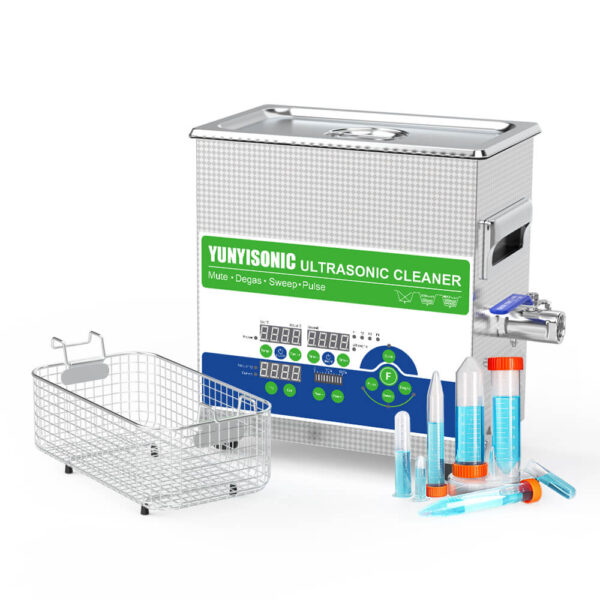


For most real-world tasks, yes—ultrasonic cleaners need a suitable cleaning solution to deliver dependable results. While plain water can dislodge light, water-soluble dust, the ultrasonic unit only supplies physical cavitation energy. It is the chemical solution that loosens, dissolves, emulsifies, and suspends stubborn contaminants like oils, grease, polishing residue, carbon, and fingerprints. Without proper chemistry, cavitation alone often leaves behind microscopic films that compromise appearance, coating, assembly, electrical contact, or hygiene standards.
That chemistry does not need to be overly aggressive to be effective. Mild, low-foaming neutral detergents work well for routine tasks, while heavier soils may call for specialized alkaline degreasers, acidic descalers, or enzymatic formulas matched to the workpiece material. Ultimately, achieving consistent cleanliness depends far more on correct dilution, controlled operating temperature, and routine bath replacement than on simply using an excessively strong chemical concentration.
Click to view: Chemical Cleaning Agent
Why Solution Is Part of Most Cleaning Processes
Ultrasonic cleaners need cleaning solution because ultrasonic energy alone does not chemically dissolve contamination. An ultrasonic tank can transmit high-frequency pressure waves through plain water, but water has limited ability to wet oily surfaces, break down grease, prevent soil from settling back on parts, or remove chemically bonded deposits. A cleaning solution addresses those limitations.
In practice, the bath liquid is an active process component. It must transfer ultrasonic energy, contact every accessible surface, react with or lift the contamination, and carry the released soil away. The cleaner, the liquid, and the part form one system. If any one of these elements is poorly matched, cleaning performance becomes inconsistent.
For production, repair, laboratory, jewelry, dental, and maintenance work, a solution also improves repeatability. A defined chemical formula used at a measured dilution is easier to control than an improvised liquid mixture. It supports consistent results from one cleaning cycle to the next and makes it easier to identify why cleaning quality changes.
What an Ultrasonic Cleaning Solution Actually Does
Cleaning solution has several technical functions. It improves wetting, assists with soil removal, reduces surface tension, disperses contaminants, controls foam, and may protect compatible metal surfaces during the cleaning cycle. A solution can also reduce water hardness effects and make post-cleaning rinsing more effective.
These functions are important because the contamination on a part is rarely uniform. A machined component may have metal fines in one recess, cutting fluid in another, and fingerprints on its outer surface. A jewelry item may contain skin oils, cosmetic residue, polishing compound, and dust within a setting. One correctly selected solution can help address the relevant soils without relying on excessive ultrasonic power or unnecessarily long cleaning times.
Acoustic Cavitation Provides Physical Cleaning Energy
Ultrasonic cleaning operates through acoustic cavitation. Ultrasonic transducers generate high-frequency pressure waves in the liquid. These waves create and collapse microscopic bubbles throughout the bath. When bubbles collapse close to a submerged surface, they create localized energy that helps dislodge contamination from the workpiece.
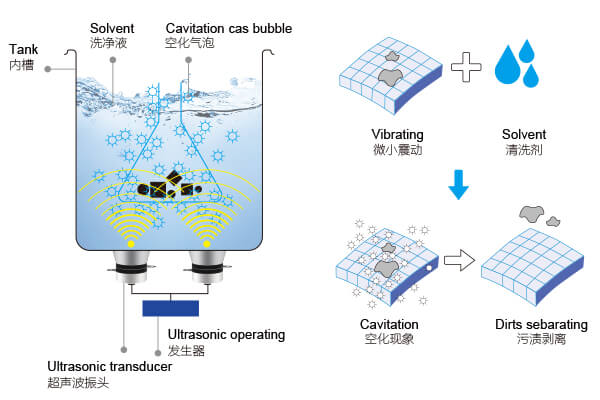
The Principle Behind Ultrasonic Cleaning
This effect allows ultrasonic cleaning to reach areas that are difficult to clean by hand, including screw threads, blind holes, narrow channels, textured surfaces, fine meshes, and complex internal passages. It is not a stirring or mixing process. The cleaning effect depends on controlled pressure-wave activity in a liquid medium and on the ability of that liquid to contact the contaminated surface.
Frequency influences the character of cavitation. General-purpose systems often operate around 40 kHz, which is commonly suitable for many hard components and routine cleaning tasks. Lower frequencies can provide more forceful cavitation for durable, heavily soiled parts, while higher frequencies can be selected for fine features and more sensitive surfaces. Regardless of frequency, acoustic cavitation is most effective when the cleaning liquid is properly formulated for the soil.
Solution Chemistry Removes and Controls Contamination
The cleaning solution performs the work that acoustic cavitation cannot complete alone. Surfactants lower surface tension, helping the liquid spread across the part and enter small gaps. This improves liquid access beneath oil films and inside recessed features. Better wetting also reduces the amount of air trapped in intricate part geometries.
For greasy contamination, surfactants and other active ingredients emulsify oil into small droplets that can remain suspended in the bath. This reduces redeposition, which occurs when released soil attaches to a different surface before the cycle is complete. For mineral deposits, selected acidic or chelating ingredients can dissolve or loosen the deposit. For some organic soils, enzymatic formulations may break down residue that a general detergent cannot remove efficiently.
A purpose-designed ultrasonic cleaning solution should also produce limited foam. Excess foam interferes with the liquid conditions needed for stable acoustic cavitation. For that reason, ordinary dish soap is usually unsuitable. It can foam excessively, leave additives or fragrance residue, and make rinsing more difficult.
Cleaning Jobs That Require a Solution
Cleaning solution is required when contamination is oily, chemically bonded, dried onto the surface, embedded in complex features, or likely to redeposit. These conditions apply to a large share of ultrasonic cleaning tasks. The more demanding the required cleanliness level, the more important it becomes to choose the solution based on technical compatibility rather than convenience.
Click to view: Industrial Metal Degreasing Powder Remove Duty Oil Grease for Machinery Automotive Parts Factory Cleaning
Oils, Grease, and Manufacturing Residues
Lubricating oils, grease, machining fluid, cutting oil, wax, polishing compound, and handling oils generally require cleaning solution. These contaminants are often hydrophobic, meaning they do not dissolve in water effectively. A water-based degreasing solution helps detach and disperse the soil while the ultrasonic field reaches difficult geometries.
Mechanical parts can retain contamination in threaded sections, drilled holes, fuel passages, valve bodies, and other enclosed areas. Extending ultrasonic time may improve removal of loose particles, but it will not compensate for a solution that cannot dissolve or emulsify the oily film. The bath chemistry must be chosen to suit the residue and the base material.
Carburetors and fuel-system components are typical examples. Fuel varnish, oil residue, oxidation, and particulate contamination can coexist on the same assembly. A compatible water-based solution, controlled temperature, and thorough rinsing are central to the process. The detailed guidance in Ultrasonic Cleaner Solutions for Carburetors: How to Deep Clean for Peak Performance explains why disassembly, solution selection, and drying are as important as the ultrasonic cycle.
Tarnish, Oxides, Scale, and Organic Deposits
Tarnish, oxidation, and mineral scale usually need specialized cleaning chemistry. These deposits are not simply loose surface dirt. Tarnish on silver, brass, and copper may involve sulfide or oxide layers. Hard-water scale can consist of mineral deposits that are resistant to neutral detergents. Water or a general-purpose degreaser may clean surrounding dirt while leaving these surface layers unchanged.
Acidic or chelating formulations may be appropriate for selected scale and oxidation problems, but they require caution. Chemistry that removes mineral deposits can also etch aluminum, darken copper alloys, damage zinc, or affect plating. Tank compatibility is also important because aggressive chemicals can shorten the service life of stainless steel tanks, seals, heaters, drains, and filtration components.
Jewelry requires an even more selective approach. A mild solution may help remove oils, cosmetics, and dirt from robust precious-metal jewelry, but ultrasonic cleaning is not suitable for every gemstone, adhesive, treatment, or setting. The material-specific considerations in Ultrasonic Jewelry Cleaning Solutions Guide are useful when selecting low-residue chemistry and identifying jewelry that should not be cleaned ultrasonically.
Situations Where Solution Is Not Essential
Cleaning solution is not always essential when the soil is loose, light, fresh, and water-soluble. Dust, soluble salts, loose particles, and some water-based residues may be removed with water in a suitable ultrasonic tank. Water may also be used for rinsing after the main cleaning stage.
These are exceptions rather than the basis for most cleaning processes. A part can look visibly clean after a water-only cycle yet retain a thin oil film, mineral residue, or trace contamination in hidden areas. When the part will be bonded, painted, plated, assembled, inspected, or used in a critical application, a defined cleaning solution and rinse process provide more dependable control.
Water quality also affects results. Tap water can leave calcium, magnesium, silica, or other mineral residues after drying. Distilled, reverse-osmosis, or deionized water is often preferred for final rinsing of precision parts, glass, optics, or surfaces where spotting is unacceptable. Better water quality reduces residue but does not replace a cleaning solution when difficult soils are present.

Water
How to Choose the Right Cleaning Solution
Solution selection should begin with the contamination, then move to material compatibility and operating conditions. The correct question is not which liquid is strongest, but which formula can remove the required soil at the lowest practical chemical aggressiveness. This reduces the risk of etching, staining, coating damage, foam, poor rinsability, and unnecessary operating cost.
Neutral, Alkaline, Acidic, and Enzymatic Options
- Neutral solutions are appropriate for general cleaning, fingerprints, light oils, dust, and mixed-material loads where a mild chemistry is needed.
- Alkaline solutions are commonly used for oils, grease, machining fluids, and robust metal components.
- Acidic solutions can address selected mineral deposits, oxidation, and scale, subject to strict material and tank compatibility checks.
- Enzymatic solutions may be used for defined organic or protein-based contamination where process instructions specify their use.
- Specialty solutions may be necessary for aluminum, copper alloys, jewelry, optical parts, electronics, or precision manufacturing components.
The supplier’s technical data should identify concentration range, operating temperature, compatible materials, rinsing requirements, and safety controls. Chemical safety documentation should be reviewed before use. A solution that works at room temperature may become much more active at elevated temperature, which can change its effect on sensitive materials.
Material Compatibility and Process Validation
Every material exposed to the bath must be considered. This includes not only the main part body, but also coatings, plating, elastomer seals, adhesives, labels, solder joints, stone settings, plastic inserts, and protective finishes. A steel component with a small aluminum fitting or bonded seal may be limited by that secondary material.
Short validation cycles are recommended for unfamiliar parts or new solutions. Inspect for color change, haze, pitting, coating loss, swelling, cracking, or trapped liquid after cleaning. When cleaning high-value components or production batches, documented process settings improve traceability and reduce the chance of repeated material damage.
Liquids That Should Not Go into an Ultrasonic Tank
Flammable solvents should not be placed directly in a standard ultrasonic cleaner tank. Liquids such as gasoline, acetone, and many alcohol-based or solvent-based cleaners can release flammable vapor, particularly when heated. Standard aqueous ultrasonic cleaners are not automatically designed for direct solvent use.
Bleach, chlorine-containing cleaners, highly caustic products, and strong acids should also be avoided unless explicit compatibility is confirmed for the equipment and the chemical. These substances can corrode tank materials, damage seals and heaters, generate hazardous fumes, and react with residues from prior cleaning cycles. Chemicals should never be mixed without verified process instructions.
Common Solution-Related Cleaning Problems
Weak cleaning performance often indicates unsuitable chemistry, a depleted bath, incorrect dilution, low operating temperature, inadequate degassing, or overloaded baskets. Increasing cycle time should not be the first response. Longer exposure can increase the risk of surface wear or material damage without removing contamination that the solution cannot address.
Persistent foam usually means that the solution is unsuitable, over-concentrated, or heavily contaminated. Foam absorbs energy and reduces the conditions needed for effective acoustic cavitation. Drain and clean the tank when necessary, then refill it with a low-foam solution intended for ultrasonic cleaning.
White deposits, streaks, or spots after drying may result from hard water, excessive concentrate, poor rinsing, or an exhausted bath. Discoloration, pitting, softened plastics, or dull plating can indicate chemical incompatibility. Stop the process and reassess concentration, temperature, exposure time, and material suitability before cleaning more parts.
Cleaning Bath Maintenance
The cleaning bath should be replaced when it becomes visibly dirty, loses cleaning effectiveness, develops persistent foam, produces odor, or reaches the service limit stated for the solution. A heavily contaminated bath can redeposit oil and fine particles onto cleaned workpieces. In controlled industrial processes, pH, concentration, conductivity, temperature, and soil loading may be monitored to maintain quality.
After draining the tank, rinse away residues and wipe the tank with a soft non-abrasive cloth. Inspect baskets, lids, drains, filters, heaters, and tank seams during routine maintenance. Good bath management improves cleaning consistency and helps maintain the performance of the ultrasonic system.