


Yes. Tap water is suitable for general ultrasonic cleaning, but precision applications require purified water due to dissolved minerals and gases.
Tap water can be used when the equipment permits water-based operation and the workpiece does not require a residue-free surface. However, dissolved minerals—such as calcium, chlorides, and silica—cause scale buildup on tanks and leave spots on precision components. Cleaning processes that require clean, residue-free surfaces require distilled, deionized, or desalinated water, particularly during final rinsing.
Additionally, dissolved gases in fresh tap water attenuate ultrasonic cavitation. The bath must be degassed prior to cleaning to ensure cavitation efficiency.
Selection by Application:
- Tap Water: Workshop tools, non-critical hardware, and preliminary wash cycles.
- Purified Water: Optics, electronics, and surfaces where mineral residues or ionic contamination cannot be tolerated.
Water
Why Water Quality Affects Ultrasonic Cleaning
Minerals, Hardness, and Dissolved Solids
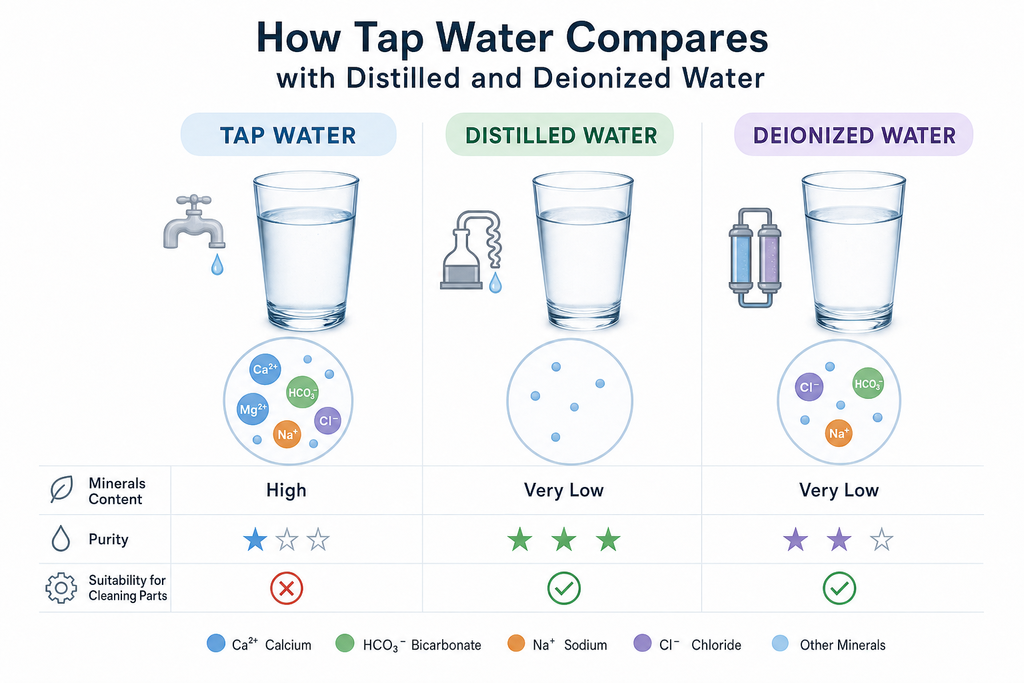
Tap water is not chemically identical from one location to another. It may contain calcium, magnesium, bicarbonate, chloride, sulfate, silica, sodium, and other dissolved substances. The concentration depends on the local water source, treatment process, plumbing system, and seasonal conditions.
Hard water contains higher levels of calcium and magnesium. When hard water is heated or evaporates, these minerals can form deposits on the tank, heating elements, basket, and cleaned parts. The deposits may appear as white spots, cloudy films, or rough scale.
Minerals do not normally prevent ultrasonic cleaning from taking place. The transducers can still generate pressure waves and acoustic cavitation in tap water. The main concern is that dissolved solids may remain on the parts or accumulate inside the equipment after the water dries.
For general cleaning, this residue may be acceptable. For optical components, polished metal, electronics, laboratory parts, medical instruments, or decorative products, even a small mineral film may be unacceptable.
Cleaning Performance and Acoustic Cavitation
The Principle Behind Ultrasonic Cleaning
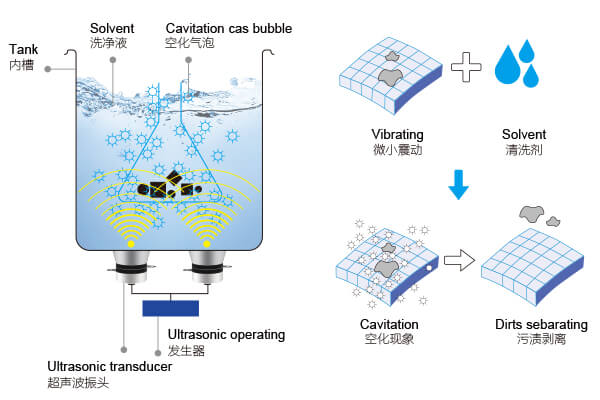
An ultrasonic cleaner uses electrical energy and transducers to generate high-frequency pressure waves in a liquid. Under suitable conditions, these waves create and collapse microscopic cavitation bubbles.
The collapse of the bubbles produces localized turbulence, shear forces, and liquid microjets near solid surfaces. These effects help loosen oil, dirt, particles, polishing residue, and other contamination from immersed parts.
Water quality can influence the behavior of the cleaning bath. Dissolved gases affect the initial formation of cavitation bubbles, while temperature, viscosity, surface tension, and dissolved solids affect the operating conditions. Tap water can support ultrasonic cleaning, but the cleaning result may vary depending on its composition.
The ultrasonic cleaner does not rely on mechanical stirring as its basic operating principle. If a system includes a separate pump, mechanical circulation, or spray function, that feature should be evaluated separately from the acoustic cavitation produced by the transducers.
Residue, Scaling, and Corrosion Risk
The most common limitation of tap water is residue after drying. Minerals carried in the water can remain on the surface as the liquid evaporates. This is especially visible on glass, polished stainless steel, jewelry, dark coatings, and optical surfaces.
Scale can also reduce equipment performance. Mineral deposits may accumulate on heating elements and tank surfaces, affecting heat transfer and making the tank more difficult to clean. Severe scale may require descaling according to the equipment manufacturer’s instructions.
Tap water chemistry may also affect corrosion. Chloride and other ions can increase corrosion risk for certain metals, especially when combined with heat, long exposure, crevices, or an unsuitable detergent. Water quality is only one factor, but it should be considered when cleaning reactive alloys, carbon steel, aluminum, copper, and plated components.
How Tap Water Compares with Distilled and Deionized Water
How Tap Water Compares with Distilled and Deionized Water
When Tap Water Is Suitable
Tap water is suitable for many routine cleaning tasks when the parts do not require a residue-free finish. Typical examples include hand tools, workshop hardware, machine parts, maintenance components, and durable metal items.
It can also be used as the initial cleaning bath when the main goal is to remove heavy dirt, oil, grease, or loose particles. A later rinse with purified water may then be used to improve the final surface condition.
The suitability of tap water should still be confirmed against the equipment manual. Some machines are designed for water-based cleaning but require a specific water quality, detergent, or rinse process.
When Purified Water Is Better
Distilled, deionized, or fully desalinated water contains fewer dissolved minerals and ions than ordinary tap water. These water types are useful when the process must reduce water spots, mineral residue, ionic contamination, or conductivity.
Purified water is often preferred for:
- Optical glass and coated lenses
- Polished or decorative metal surfaces
- Electronic and electrical components approved for aqueous cleaning
- Laboratory instruments
- Medical and dental components
- Precision parts with narrow tolerances
- Final rinsing before controlled drying
Deionized water does not automatically remove all organic contamination. It has low ionic content, but it may still require a compatible detergent for oil, grease, and other soils. Water purity and cleaning chemistry solve different problems.
Using Different Water Types in Cleaning and Rinsing
The cleaning bath and rinse water do not need to be identical in every process. Tap water may be used for the main cleaning stage, while deionized or distilled water is used for the final rinse.
This arrangement can reduce operating cost while improving the appearance and cleanliness of the finished part. The first stage removes the main contamination, and the final rinse reduces the mineral residue that would otherwise remain after drying.
For precision work, a two-stage or multi-stage process may include pre-rinsing, ultrasonic cleaning with detergent, intermediate rinsing, final rinsing with purified water, and controlled drying. The number of stages depends on the required cleanliness level and the geometry of the parts.
Which Applications Can Use Tap Water?
General Workshop Cleaning
Tap water is commonly suitable for general workshop cleaning when the parts are durable and the final appearance does not require a mineral-free finish. Examples include steel tools, fasteners, machine components, workshop fixtures, and maintenance parts.
A water-based detergent can be added when oil or grease must be removed. After cleaning, the parts should be rinsed and dried promptly to reduce corrosion and water spotting.
Carbon steel requires particular attention because remaining water can promote flash rust. A corrosion inhibitor or protective oil may be necessary when the parts will be stored after cleaning.
Jewelry and Household Items
Tap water may be acceptable for some jewelry and household items when the material is compatible and water spots are not a major concern. The presence of tap water does not make a jewelry piece safe for ultrasonic cleaning, however. Gemstones, coatings, plating, adhesives, and loose settings must be evaluated separately.
Gold and platinum jewelry with suitable untreated gemstones may tolerate a controlled ultrasonic cycle, while pearls, opals, porous stones, treated gemstones, and glued components may require a different cleaning method.
For valuable jewelry, purified water may improve the final appearance, but water quality does not eliminate the risk associated with fragile stones or weak settings.
Precision, Optical, Medical, and Electronic Components
Tap water may be suitable for an initial cleaning stage, but it is often less suitable for final rinsing of precision components. Mineral deposits can affect optical clarity, electrical performance, surface appearance, or dimensional inspection.
Medical and dental components may require controlled water quality, validated detergents, defined rinse stages, and documented drying. Equipment manufacturers may specify deionized water for certain stages of the process.
Electronic components should be immersed only when the component manufacturer or process documentation permits aqueous ultrasonic cleaning. Tap-water minerals and detergent residues may create ionic contamination if rinsing and drying are incomplete.
Common Problems Caused by Tap Water
White Mineral Deposits
White spots or powdery deposits are usually caused by dissolved minerals left behind after evaporation. They are more common when tap water is hard, the parts are not rinsed, or the cleaning bath is heated.
A final rinse with distilled or deionized water can reduce this problem. Existing deposits may require a compatible descaling or cleaning process, but acidic chemicals should not be used without checking material compatibility.
Water Spots and Cloudy Surfaces
Water spots are especially visible on black coatings, polished metal, glass, mirrors, and optical surfaces. Drying conditions also matter. Slow evaporation can concentrate minerals and make spotting more visible.
Using purified water for the final rinse, reducing residual liquid, and drying promptly can improve appearance. A clean microfiber cloth or filtered air may be suitable for some parts, while precision components may require controlled drying equipment.
Scale and Reduced Equipment Performance
Hard-water scale can accumulate on tank walls, heaters, baskets, and drains. Scale may reduce heat-transfer efficiency, make the equipment harder to clean, and contribute to unstable process conditions.
The tank should be inspected regularly. Descaling should follow the equipment manufacturer’s instructions because strong acids may damage stainless steel, seals, transducers, or other components.
Corrosion and Contamination Control
Tap water may contain ions that increase corrosion risk for certain metals, particularly when the bath is hot, the exposure time is long, or the parts contain crevices. The risk depends on the water chemistry, detergent, alloy, and process conditions.
Used bath water also contains removed soil. As contamination accumulates, the solution may lose cleaning performance and redeposit particles onto the parts. The bath should be replaced when it becomes visibly dirty, oily, excessively foamy, or less effective.
How to Improve Results When Using Tap Water
Tap water can provide acceptable results when the process is designed around its limitations. The following practices help control residue and maintain cleaning performance:
- Use the lowest mineral-content water available when final appearance is important.
- Use a compatible low-foaming detergent at the recommended dilution.
- Degas the freshly prepared bath according to the equipment manual.
- Keep the parts in a basket and avoid direct contact with the tank bottom.
- Do not overload the basket or allow parts to contact one another.
- Use a separate purified-water rinse when mineral residue is unacceptable.
- Dry parts promptly after rinsing.
- Replace the bath when it becomes contaminated or cleaning performance declines.
- Inspect the tank for scale and clean it according to the manufacturer’s instructions.
For production cleaning, water quality should be monitored rather than assumed. Useful measurements may include conductivity, total dissolved solids, hardness, chloride level, and visual residue after drying. The required test depends on the application and cleanliness specification.
A simple comparison test can help determine whether tap water is adequate. Clean identical parts using tap water and purified water under the same detergent, temperature, and cycle conditions. After rinsing and drying, compare surface appearance, residue, corrosion, and cleaning performance.