

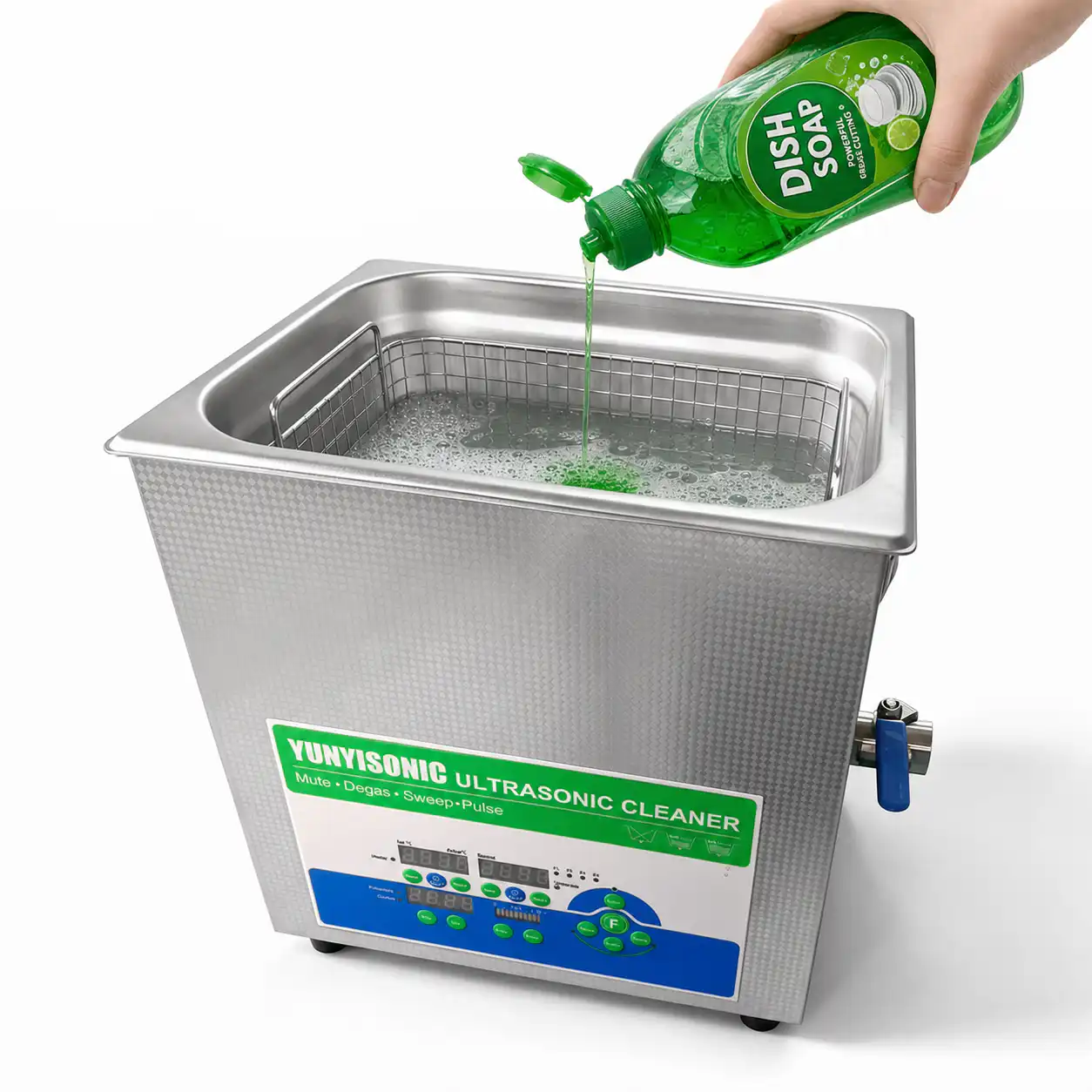

Yes, soap or detergent can be used in an ultrasonic cleaner, but only when it is compatible with the equipment, the workpiece material, and the cleaning process. A mild, water-based, low-foaming detergent formulated for ultrasonic cleaning is generally the most reliable option. Ordinary household dish soap may be acceptable for occasional light-duty cleaning of durable items, but it is not specifically engineered for ultrasonic equipment.
The main consideration is not simply whether soap can dissolve dirt, but how its formulation behaves under ultrasonic cleaning. Some household soaps may produce excessive foam, leave persistent residues, reduce cleaning consistency, or contain additives that affect soft metals, seals, coatings, or other sensitive materials.
For standard cleaning operations, the preferred approach is to use a low-foaming ultrasonic detergent at the manufacturer’s recommended dilution. If household soap is used temporarily, select the lowest effective concentration and verify compatibility with both the equipment and the workpiece before regular use.
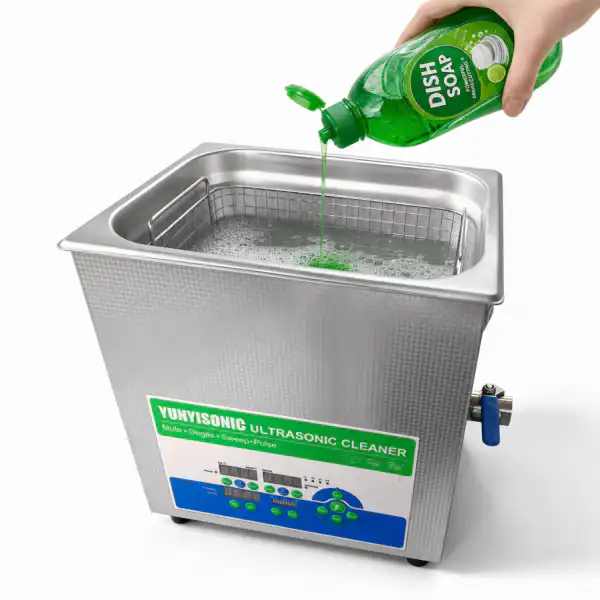
A small amount of dishwashing liquid is being added to the ultrasonic cleaning tank
1. Why Chemistry Selection Matters in Ultrasonic Cleaning
Household Soap vs. Ultrasonic Cleaning Detergent
The word “soap” is commonly used to describe products ranging from dishwashing liquid and hand soap to laundry detergent, bar soap, and industrial degreasers. These products can have very different chemical compositions and operating characteristics.
Traditional soaps are made from fatty-acid salts, while many modern household cleaning liquids rely on synthetic surfactants combined with thickeners, moisturizers, fragrances, preservatives, dyes, and foam-stabilizing agents. These additives are designed to produce stable lather during manual scrubbing. In an ultrasonic cleaner, however, excessive stable foam can reduce cleaning consistency.
Dedicated ultrasonic detergents are engineered for immersion cleaning and acoustic agitation. They typically use low-foaming surfactants that help wet surfaces, reduce surface tension, suspend removed contaminants, and rinse away without leaving excessive films or residues.
Using household dish soap does not necessarily cause immediate equipment failure, but its performance may be unpredictable under ultrasonic energy, elevated bath temperatures, and extended operating cycles. The formulation may also be unsuitable for the material being cleaned.
Foam, Surface Tension, and Acoustic Cavitation
An ultrasonic cleaner converts high-frequency electrical energy into mechanical vibration within a liquid bath. Alternating pressure waves cause microscopic cavitation bubbles to form and collapse rapidly. Their collapse produces localized turbulence, shear forces, and, near solid surfaces, liquid microjets that help dislodge contaminants.
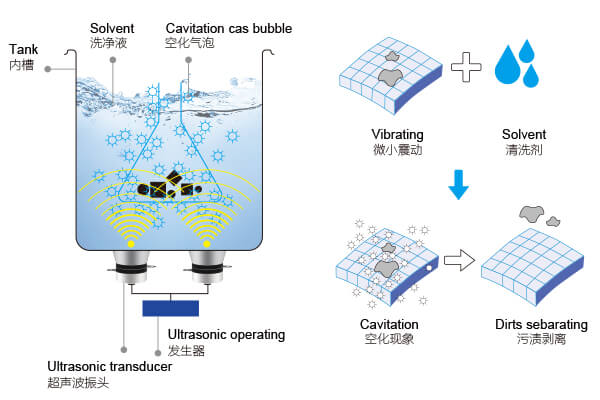
The Principle Behind Ultrasonic Cleaning
Liquid chemistry affects this process. Suitable surfactants can improve wetting and help the cleaning solution reach fine features, blind holes, and recessed areas. However, excessive surfactant concentration may increase foaming and reduce cleaning consistency.
- Surface Wetting: Suitable surfactants can help the solution spread across the workpiece and reach narrow or recessed areas.
- Foam Control: Excessive foam can interfere with acoustic energy transfer and reduce the consistency of cavitation near the workpiece.
- Operational Control: Heavy foam can spill over tank rims, obscure the workpieces, contaminate surrounding surfaces, and interfere with equipment operation.
For these reasons, low-foaming chemistry is generally preferred for ultrasonic cleaning, particularly in precision or production applications.
Material and Equipment Compatibility
The selected cleaning agent must be compatible with both the workpiece and the ultrasonic cleaner. A chemical that safely cleans stainless steel may discolor, etch, or corrode aluminum, brass, copper, zinc, rubber, or specialty coatings.
The cleaning solution can also affect the service life of the tank and internal components. High concentrations of chlorides, strong acids, bleach, or highly caustic solutions may cause pitting, staining, or other forms of corrosion in stainless-steel tanks, particularly when combined with elevated temperatures and prolonged exposure.
Always consult the equipment manual for approved chemical types, concentration limits, temperature restrictions, and prohibited substances. When the material or chemical compatibility is uncertain, perform a test on a representative noncritical part before processing valuable or production components.
2. What Types of Detergents Can Be Used?
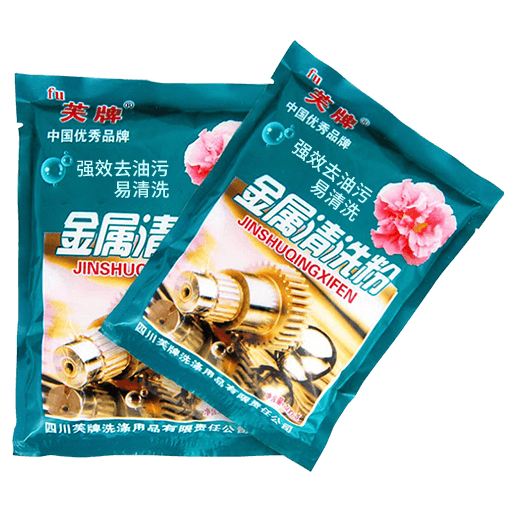
Click to view: Industrial Metal Degreasing Powder Remove Duty Oil Grease for Machinery Automotive Parts Factory Cleaning
Low-Foaming Aqueous Cleaners
Water-based, low-foaming concentrates formulated for ultrasonic systems generally provide the best balance of cleaning performance and material protection. Depending on the contamination and substrate, these formulations may include:
- Neutral Formulations: Often selected for sensitive materials, optical glass, medical devices, precision plastics, and mixed-material assemblies.
- Mildly Alkaline Formulations: Commonly used to remove machining oils, cutting fluids, grease, and polishing compounds from ferrous metals and durable alloys.
- Enzymatic Formulations: Used for certain biological contaminants, proteins, and clinical soils when the product is specifically approved for the application.
These categories are general descriptions rather than universal industry standards. The actual pH range, concentration, temperature limit, and material compatibility depend on the specific product and its technical documentation.
When Household Dish Soap May Be Acceptable
A small amount of mild, unscented dishwashing liquid may be acceptable for occasional light-duty cleaning of simple, durable items such as stainless-steel hand tools or basic hardware, provided that the equipment manual permits water-based detergents.
Household dish soap should generally be avoided for:
- Coated optics and precision lenses
- Electronic assemblies and circuit boards
- Fine jewelry with porous or glued gemstones, such as pearls, opals, and some emeralds
- Regulated dental appliances and medical devices
- High-precision production components requiring very low residual contamination
- Parts made from sensitive plastics, elastomers, or specialty coatings
If household dish soap is used as a temporary solution, use only the minimum amount permitted by the equipment and detergent instructions. Monitor the bath for foam, inspect the workpiece for discoloration or residue, and rinse both the parts and tank thoroughly after the cycle.
3. Best Practices for Using Detergents in an Ultrasonic Cleaner
1. Dilute Accurately
More detergent does not necessarily produce better cleaning. Excessive concentration can change the physical properties of the solution, increase foaming, complicate rinsing, and reduce cleaning consistency.
Always measure the detergent according to the manufacturer’s recommended dilution ratio and the actual liquid volume in the tank. If the workpiece or contamination is new to the process, begin with the lowest effective concentration and increase it only when testing shows that additional cleaning strength is necessary.
2. Degas the Solution
Freshly prepared water contains dissolved gases that can reduce ultrasonic cleaning efficiency during the initial operating stage. Use the cleaner’s built-in degas mode or follow the equipment manufacturer’s instructions.
Many benchtop units recommend approximately 10 minutes of degassing for a freshly prepared bath, but the correct time depends on the equipment, liquid volume, temperature, and solution chemistry. Degassing should be completed before loading parts when the machine design or operating instructions require it.
3. Always Use a Basket
Do not place parts or containers directly on the bottom of the ultrasonic tank. Direct contact can damage both the workpiece and the tank, interfere with liquid circulation, and produce uneven cleaning.
Use the manufacturer-approved mesh basket, rack, or fixture. The support should keep the parts suspended above the tank bottom while allowing the cleaning solution to contact all relevant surfaces.
4. Orient Parts Correctly
Position hollow parts, blind holes, and complex channels so that trapped air can escape and the cleaning solution can reach the contaminated surfaces. Poor orientation can create air pockets that shield areas from cavitation.
Parts should not be stacked tightly. Overloading the basket can restrict liquid movement, create acoustic shadowing, and cause parts to contact one another during the cycle.
5. Rinse and Dry Promptly
Ultrasonic cleaning suspends soil and detergent residues in the bath. After removing the parts, rinse them promptly with clean water to remove remaining surfactants and loosened particles.
Deionized or reverse-osmosis water may be appropriate for precision components when mineral deposits or water spots must be minimized. The rinse method should be selected according to the material and cleanliness requirements.
Dry parts promptly with filtered compressed air, warm air, or another approved method. Prompt drying helps prevent flash rust on carbon steel, water spotting on polished surfaces, and moisture-related problems on sensitive components.
4. Substrate Compatibility Guide
- Ferrous Metals and Stainless Steel: Often compatible with neutral and mildly alkaline cleaners, provided that the concentration, temperature, and exposure time are controlled. Carbon steel should be dried immediately after rinsing or treated with a suitable rust inhibitor to reduce oxidation.
- Aluminum and Soft Alloys: May be susceptible to etching, darkening, or discoloration in high-pH environments. Use neutral detergents or alkaline cleaners specifically formulated with corrosion protection for nonferrous metals.
- Plastics and Elastomers: Require compatibility testing. Certain surfactants, additives, temperatures, and exposure times may cause polymers or rubber seals to swell, harden, soften, become brittle, or develop stress cracking.
- Coated, Plated, or Painted Surfaces: May be affected by chemical exposure and ultrasonic cleaning, particularly when the coating is already damaged or poorly bonded. Test an inconspicuous area before regular processing.
- Jewelry and Precision Items: Solid gold and platinum components may tolerate mild ultrasonic cleaning, but gemstone type, treatment history, setting condition, adhesives, coatings, and porous materials must be evaluated separately.
- Electronic Components: Should be immersed only when the component manufacturer or process documentation permits aqueous ultrasonic cleaning. Batteries, displays, microphones, speakers, sealed switches, and moisture-sensitive assemblies may be damaged.
5. Troubleshooting Common Issues
| Problem | Probable Cause | Recommended Corrective Action |
|---|---|---|
| Excessive Surface Foam | Unsuitable detergent, excessive concentration, heavily contaminated bath, or unsuitable operating conditions | Switch to a low-foaming detergent, follow the recommended dilution, replace the contaminated bath, and verify the operating temperature and load |
| Sticky Film or White Residue | Incomplete rinsing, spent cleaning bath, excessive detergent concentration, or high dissolved solids | Increase the rinse effectiveness, use fresh rinse water, consider deionized water for precision parts, and replace the dirty bath solution |
| Metal Discoloration or Etching | Incompatible pH, excessive concentration, high bath temperature, or excessive exposure time | Select a formulation matched to the metal, reduce the concentration or temperature, shorten the cycle, and test the process on a representative part |
| Diminished Cleaning Performance | Solution not properly degassed, bath saturated with oil or sludge, overloaded basket, poor part orientation, or parts placed on the tank bottom | Run the recommended degassing cycle, replace the cleaning solution, reduce the load, reposition the parts, and use a suitable basket |