


Ultrasonic cleaning may seem like a modern marvel, but the science behind it is rooted in simple yet powerful physics. At its core, the process involves the conversion of high-frequency electrical energy into mechanical vibrations, which are transmitted through a liquid medium—typically water or a specialized cleaning solution. These vibrations generate microscopic bubbles in a phenomenon known as cavitation.
Cavitation is the heart of ultrasonic cleaning. When these bubbles form and collapse rapidly, they release concentrated energy in the form of tiny shockwaves. These shockwaves effectively loosen and remove contaminants from the surfaces and even the tiniest crevices of submerged items. Importantly, the frequency at which these vibrations occur directly influences how these bubbles behave—and, by extension, what type of cleaning result you can expect.
Lower frequencies, such as 25 or 28kHz, produce larger cavitation bubbles that collapse with more force. This makes them effective for blasting away heavy dirt, grease, and rust from durable industrial parts. On the flip side, higher frequencies—such as 80kHz or 120kHz—generate smaller bubbles that implode with less force but with more precision. These are ideal for delicate items like electronic components, watch parts, or optical lenses, where too much force could cause damage.
Ultrasonic cleaners aren’t just about “buzzing at a high pitch.” Their performance is tightly tuned to the exact frequency used, and the choice of frequency is far from arbitrary. It affects not just the cleaning depth, but also the safety, duration, and effectiveness of the entire process.
The more you understand about how frequency shapes cleaning behavior, the more strategic you can be about using or selecting an ultrasonic cleaner. Whether you’re cleaning carburetors in a garage or semiconductor wafers in a cleanroom, getting the frequency right is often the key to a successful operation.
What Is Ultrasonic Frequency and How Is It Measured?
Ultrasonic frequency refers to sound waves that vibrate at a rate above the human hearing range, typically starting at 20,000 hertz (Hz). For ultrasonic cleaning, these frequencies usually fall within the 20kHz to 200kHz range, though some specialized systems may operate even higher.
Frequency is measured in kilohertz (kHz), where 1kHz equals 1,000 Hz. In practical terms, a 40kHz ultrasonic cleaner emits 40,000 sound vibrations per second. These vibrations pass from a piezoelectric transducer into a cleaning fluid—usually water mixed with a detergent—and that’s where the magic begins.
When ultrasonic energy enters the liquid, it produces alternating high- and low-pressure waves. During the low-pressure phase, tiny vacuum bubbles form. In the high-pressure phase, they collapse violently. This repeated action creates a scrubbing effect at the microscopic level.
Frequencies below 40kHz are generally considered low-frequency, producing larger cavitation bubbles. They’re great for dislodging thick or coarse debris. Frequencies above 80kHz are considered high-frequency and are best for more fragile or intricate parts that need gentle treatment.
To illustrate:
- 25kHz = 25,000 vibrations per second (larger, stronger bubbles)
- 40kHz = 40,000 vibrations per second (balanced force and penetration)
- 80kHz = 80,000 vibrations per second (smaller, gentler bubbles)
It’s important to note that frequency alone doesn’t determine the cleaning outcome—solution chemistry, temperature, and cleaning time also matter—but it does set the stage for what kind of contamination can be targeted effectively.
Why Frequency Matters in Ultrasonic Cleaning
If you’ve ever wondered why some ultrasonic cleaners perform better than others, the answer often comes down to frequency selection. Frequency shapes the size, intensity, and behavior of cavitation bubbles. And since those bubbles do the cleaning, their characteristics matter deeply.
Let’s start with cavitation bubble size. Lower frequencies generate larger bubbles that release greater energy when they collapse. This leads to more aggressive cleaning action—perfect for removing tough carbon deposits, baked-on grease, or oxide layers from robust surfaces. But this same intensity can damage softer materials or delicate components.
Higher frequencies produce smaller cavitation bubbles. These collapse with less energy but occur in greater density. The result? A gentler, more uniformly distributed cleaning effect, ideal for removing fine particles, polishing residues, or fingerprints from sensitive items like lab slides, camera lenses, or microelectronic wafers.
Another aspect is penetration depth. Lower frequencies tend to reach deeper into irregular geometries or complex assemblies, while higher frequencies excel in surface cleaning where precision and material preservation are crucial.
Here’s how this plays out in real-life scenarios:
- A 40kHz ultrasonic bath is well-suited for medical instruments. It delivers enough power to remove organic residues but is gentle enough not to harm sharp edges or corrosion-prone metals.
- An 80kHz unit is commonly used in cleanrooms for semiconductors, where even a tiny scratch or ion disturbance could render a component useless.
Frequency also influences audiability and noise control. Lower-frequency units are louder and may require sound-dampening covers in workplace settings. Higher-frequency systems tend to operate more quietly—a consideration in environments where noise pollution matters.
The bottom line? Choosing the correct ultrasonic frequency isn’t just a technical detail—it’s a strategic decision that directly affects cleaning quality, speed, safety, and cost.
Most Common Frequencies in Ultrasonic Cleaning Machines
Ultrasonic cleaners come in many shapes, sizes, and configurations—but the frequency they operate at often defines their most suitable application. Across industries, a handful of frequencies are commonly used, each tailored to specific cleaning needs.
25kHz – For Heavy-Duty Industrial Cleaning
The 25khz frequency is one of the lowest used in ultrasonic cleaning and produces large cavitation bubbles. These collapse with high energy, making them ideal for dislodging coarse contaminants, such as grease, carbon deposits, and rust.
You’ll typically find 25kHz systems in automotive workshops, manufacturing plants, and aerospace facilities, where large metal parts like engine blocks, fuel injectors, or brake components need aggressive treatment. However, due to the force involved, this frequency isn’t suitable for soft or fragile materials.
28–33kHz – General Purpose Cleaning for Durable Items
The 28kHz to 33kHz range strikes a balance between intensity and versatility. This frequency is slightly gentler than 25kHz but still delivers enough power to clean metal tooling, mechanical components, firearms, and molds.
It’s a favorite among industrial cleaning operators who want strong results without risking surface pitting. For many manufacturers, this is the default setting for batch ultrasonic systems because it provides dependable cavitation without excessive wear.
40kHz – The Universal Standard
If there is a “gold standard” frequency in ultrasonic cleaning, it’s 40 kHz. This frequency produces cavitation bubbles of moderate size and energy, making it effective for removing contaminants from both robust and moderately delicate parts.
You’ll find 40kHz systems in:
- Medical and dental clinics for cleaning surgical instruments
- Laboratories for glassware and slides
- Jewelry repair shops for gold, platinum, and gemstones
- Electronics manufacturers for cleaning circuit boards
Its popularity stems from versatility—it’s aggressive enough to remove grime and organic material, yet gentle enough not to damage most substrates.
68–80kHz – For Precision Electronics and Optical Equipment
As frequency increases, cavitation bubbles get smaller and more numerous, resulting in finer cleaning. The 68kHz to 80kHz range is commonly used in cleanroom environments for items such as:
- Printed circuit boards (PCBs)
- Optical lenses
- Fine instrumentation
- Micro-mechanical parts
Cleaning at this level removes microscopic particles and residues that could otherwise compromise performance. However, the reduced cavitation intensity means it’s not suitable for thick grease or heavy contamination.
120–130kHz – For Delicate Materials and Microparticles
Moving into ultrahigh-frequency territory, 120kHz to 130kHz is used for cleaning applications where the gentlest treatment is critical. This includes:
- Semiconductor wafers
- Delicate sensors
- Nano-coated surfaces
- Watch parts and microgears
Here, the goal isn’t forceful cavitation but thorough, particle-level cleaning. The small bubbles penetrate microcrevices and gently dislodge even ion-level contamination. This frequency range is standard in industries like semiconductors, aerospace microengineering, and precision optics.
170kHz and Beyond – Ultraclean for Ultrahigh Tech
Frequencies above 170kHz are rare but vital in advanced laboratory and microfabrication settings, especially where:
- Molecular precision is needed
- Traditional cleaning could damage nanosurfaces
- There’s a risk of static discharge or vibration damage
While such machines are expensive and operate in highly controlled environments, they play a key role in medical research, nanotechnology, and aerospace innovation.
Multi-Frequency and Switchable-Frequency Cleaners
As demand for more adaptive and precise cleaning grows, multi-frequency ultrasonic cleaners are becoming the norm in professional environments. These systems offer either:
- Switchable frequencies (e.g., 40/80/120kHz)
- Simultaneous multi-frequency operation
This flexibility allows operators to clean items with varying materials and contamination levels without changing machines.
A single unit can start cleaning with 25kHz to remove hardened grime, then switch to 80kHz for finishing work on sensitive surfaces. This is particularly useful in fields like watchmaking, PCB repair, dental clinics, and R&D laboratories, where objects with different cleaning requirements are treated daily.
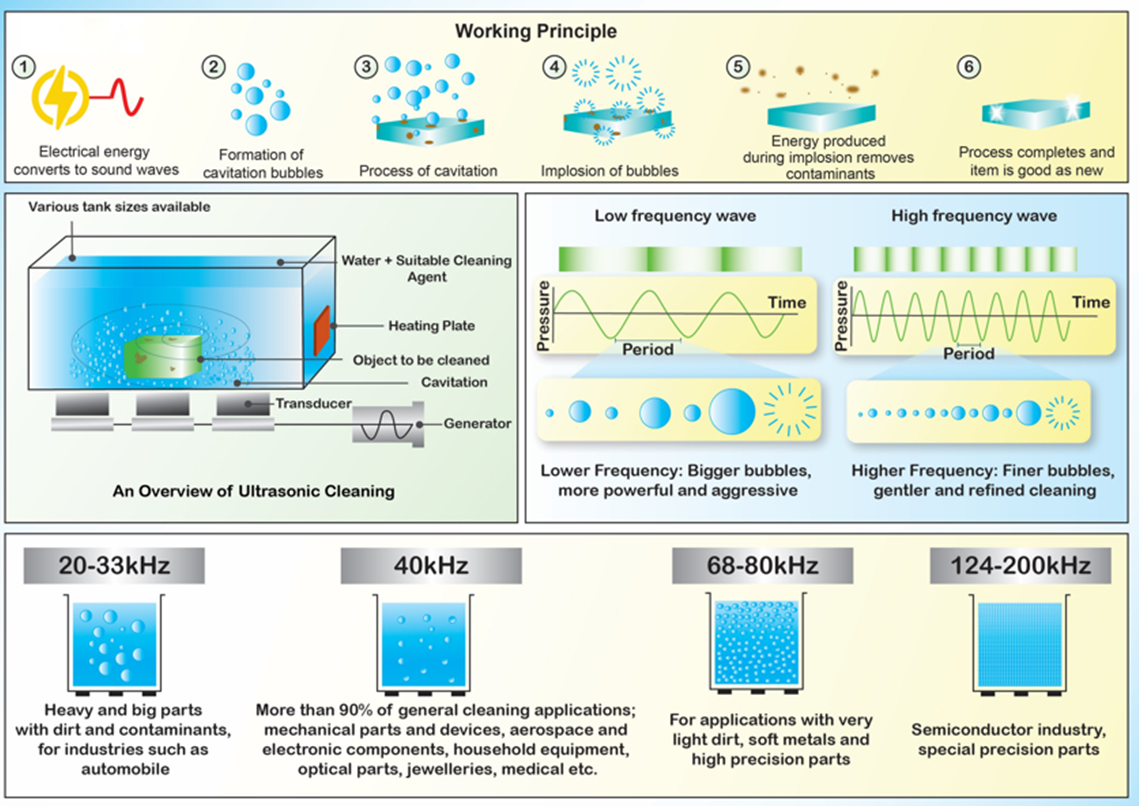
Ultrasonic Frequency Select Guide
Modern machines, such as the Yunyisonic YL or Granbo GL series, often come with digital panels that allow users to adjust not only frequency but also temperature, power, pulse mode, and degas cycles—further enhancing cleaning performance.
Multi-frequency systems also help extend equipment lifespan, since different materials may degrade if cleaned at inappropriate frequencies over time. This is especially true for soft polymers, thin coatings, and sensitive solders, which require precision care.
Factors That Influence Frequency Selection
While frequency is a critical parameter in ultrasonic cleaning, it’s never chosen in isolation. Several interdependent factors influence the optimal frequency for a specific cleaning task. Understanding these factors helps users make informed decisions when selecting or configuring ultrasonic equipment.
Type of Contamination
The first and perhaps most obvious consideration is what needs to be removed. Different contaminants respond differently to ultrasonic frequencies.
- Heavy, encrusted deposits like grease, carbon, or corrosion require lower frequencies (25–28kHz), where cavitation bubbles are larger and more powerful. These bubbles create strong shear forces that dislodge hardened residues.
- Fine dust, oils, or light organic residues are better handled by mid-range frequencies (40–80kHz) that balance cleaning power with safety.
- Sub-micron particles, polishing pastes, or ionic contamination—especially in optics or semiconductor applications—demand high-frequency (120+kHz) cleaning that reaches even microscopic crevices without damaging surfaces.
Using the wrong frequency for the contamination type may result in ineffective cleaning, or worse, surface damage.
Sensitivity of the Object
Next comes the material and fragility of the item being cleaned. Ultrasonic cleaning is inherently mechanical at the micro-level, and while it avoids abrasion, it still produces energy bursts that can deform soft or brittle objects.
For example:
- Delicate items like microelectronics, fine glassware, or gold-plated parts should never be cleaned at low frequencies. Instead, 68–132kHz is recommended to avoid pitting or deformation.
- Stainless steel tools, hard plastics, and robust metals can withstand 25–40kHz, which gives better contaminant penetration and faster cycle times.
In some industries, parts are composed of composite materials or contain adhesive bonds. Using an inappropriate frequency could weaken these bonds, loosen components, or even delaminate layered surfaces.
Part Geometry and Surface Area
Another essential factor is shape and complexity. Items with intricate geometries—think gears, watch internals, or instruments with internal channels—benefit from high-frequency ultrasonic cleaning.
Here’s why:
- High-frequency bubbles are smaller and more evenly distributed, enabling them to navigate into narrow crevices, blind holes, and fine threads.
- Low-frequency bubbles, while energetic, may struggle to reach deep or complex internal surfaces without creating dead zones.
Therefore, an object’s three-dimensional structure often dictates whether a cleaner should operate at 40kHz, 80kHz, or even higher.
Cleaning Time and Process Control
Time is money—especially in commercial or industrial cleaning operations. The selected frequency affects cleaning speed, which in turn impacts throughput and cost.
- Lower frequencies clean faster, but they can be too harsh for certain applications.
- Higher frequencies clean slower, but offer better precision and lower risk of damage.
This tradeoff becomes critical in high-volume operations like medical tool sterilization or mass jewelry processing, where dozens of cycles may run per day. Automated multi-frequency systems are often preferred here, as they can adapt cleaning cycles without manual adjustment.
Additionally, bath temperature, solution chemistry, and degassing time also impact how a given frequency performs. For example, a 40kHz cleaner with a properly degassed detergent solution at 60°C will significantly outperform a cold 40kHz bath without degassing.
Compatibility with Solution Chemistry
Certain cleaning fluids are more reactive or more viscous, affecting cavitation efficiency. For instance, solutions with surfactants may enhance bubble collapse, while highly viscous liquids (like glycol-based solvents) can dampen ultrasonic waves.
Higher frequencies are more sensitive to fluid properties. That’s why cleaning manufacturers often recommend specific solutions tailored to:
- Frequency range
- Target materials
- Contaminant chemistry
Using the wrong fluid at the wrong frequency can reduce cleaning effectiveness—or worse, cause foaming, vapor lock, or chemical incompatibility that damages the transducers.
Environmental and Safety Considerations
Frequencies also influence noise, vibration, and chemical aerosolization. Lower frequencies like 25kHz are loud—easily surpassing 100 dB—and may require enclosure or hearing protection in workplace environments. Higher frequencies, in contrast, are quieter and less disruptive.
Moreover, some applications—such as in hospital sterilization or cleanrooms—have strict limits on airborne contaminants and vibrations. In these settings, 80–170kHz systems are preferred not only for cleaning quality but for environmental compliance.
Frequency vs Power: Are They the Same?
A common misconception is that frequency and power are interchangeable in ultrasonic cleaning. In reality, they’re two distinct parameters that work together—but serve different purposes.
Frequency = Type of Cleaning
As discussed, frequency controls bubble size and behavior. It determines:
- How deep the bubbles go
- How forcefully they collapse
- How suitable the cleaning is for delicate vs durable items
Changing frequency changes the nature of the cleaning action.
Power = Intensity of Cleaning
Power, usually measured in watts, dictates how strong the ultrasonic signal is. More power means:
- More energy delivered to the fluid
- More cavitation events per second
- Faster cleaning, especially on heavily soiled items
But excessive power can cause:
- Overheating of the cleaning fluid
- Surface damage (especially at low frequencies)
- Premature wear of transducers
It’s like adjusting a water hose: frequency is the type of nozzle you use (mist, jet, shower), while power is the pressure behind it. Both matter—but they don’t mean the same thing.
Interaction Between Power and Frequency
At any given frequency, increasing power boosts cleaning speed up to a point. However, the effectiveness of power depends on the frequency. For example:
- At 25kHz, even moderate power (e.g., 200W) can be aggressive
- At 130kHz, you may need higher power (e.g., 400W+) to achieve the same cleaning depth
Therefore, equipment manufacturers usually match power output to frequency bandwidth. Some systems also offer adjustable power, allowing users to fine-tune settings for each load.
Special Industry Use Cases and Their Frequencies
The beauty of ultrasonic cleaning lies in its versatility. Industries across the globe rely on ultrasonic technology to clean everything from surgical instruments to semiconductor wafers. What sets these applications apart is not just what is cleaned, but which frequency is used—and why.
Let’s explore how different industries select frequencies based on their unique needs:
Jewelry and Watchmaking
Jewelry is one of the most common consumer-facing applications of ultrasonic cleaning. Rings, bracelets, watches, and eyeglasses all benefit from ultrasonic technology, especially for removing:
- Skin oils
- Dust
- Polishing residues
- Tarnish in crevices
Typical Frequency: 40–80kHz
Why? Because jewelry often combines precious metals, delicate stones, and intricate geometries. A mid-range frequency like 40kHz strikes a balance—strong enough to remove dirt but gentle enough to avoid dislodging gemstones or scratching polished surfaces. High-end jewelry workshops may use 80kHz for softer materials like gold or to clean vintage or antique pieces.
Note of caution: Some gemstones like pearls, opals, and emeralds are not suitable for ultrasonic cleaning, regardless of frequency, due to their porous or brittle nature.
Dental and Surgical Instruments
Hospitals and clinics depend on ultrasonic cleaners to remove biological debris from forceps, scalpels, drills, and implants. These tools must be cleaned thoroughly before sterilization to avoid cross-contamination or infection.
Typical Frequency: 40kHz
The reason 40kHz is favored is because it effectively removes blood, tissue, and protein-based residues while preserving the instrument’s edge and structure. In dentistry, where tools are smaller and more intricate, 68–80kHz is sometimes used for enhanced precision.
Devices are typically cleaned using enzymatic detergents combined with ultrasonic agitation, followed by autoclaving.
Electronics and PCB Assembly
The electronics industry depends on ultrasonic cleaning for removing flux residues, dust, and ionic contaminants from printed circuit boards (PCBs) and other delicate components. Because electronics are highly sensitive to moisture and vibration, careful frequency selection is critical.
Typical Frequency: 68–120kHz
Frequencies above 68kHz are used to protect solder joints, conductive traces, and sensitive microchips from damage. Some manufacturers even use 170kHz for ultra-fine cleaning in microelectronics and aerospace avionics.
It’s also common to use low-foaming, non-ionic cleaning agents that are safe for circuits, followed by thorough drying protocols such as vacuum ovens or nitrogen blowers.
Automotive and Aerospace Components
These industries often deal with hardened oils, metallic shavings, carbon buildup, and soot, all of which require deep, aggressive cleaning. The components—valves, nozzles, injectors, transmission parts—must be cleaned without compromising tolerances.
Typical Frequency: 25–28kHz
The low frequencies produce cavitation strong enough to blast away contaminants lodged in complex internal passages. Combined with heated alkaline solutions or degreasing solvents, ultrasonic cleaning reduces manual labor and ensures consistency across batches.
Some parts, like turbocharger blades or sensor housings, may require dual-frequency systems—starting with 25kHz to remove bulk material, then shifting to 40 or 68kHz for polishing.
Laboratory Glassware and Precision Optics
Scientific labs, especially in biotech, pharma, and analytical chemistry, rely on immaculate glassware. Residual organics, dust, or detergent spots can invalidate experiments. Similarly, optical lenses, prisms, and mirrors need a cleaning method that preserves coatings and curvature.
Typical Frequency: 80–132kHz
This frequency range is ideal for:
- Removing fine residues like dried reagents
- Preventing microabrasions on delicate surfaces
- Avoiding mechanical damage from manual scrubbing
Labs often use deionized or distilled water with non-ionic detergents, followed by rinsing in ultra-high-purity solvents.
How to Choose the Right Frequency for Your Needs
With so many frequency options and use cases, how do you choose the right one?
Here are some real-world tips for technicians, engineers, and buyers:
- Match the frequency to the fragility of the item. More delicate = higher frequency.
- Consider your contamination type. Heavy grease = low frequency. Dust and particles = high frequency.
- Don’t overlook part complexity. Small holes, blind spots, and fine threads benefit from higher frequencies.
- When in doubt, choose 40kHz. It’s the most versatile and safest starting point for general use.
For mixed-use environments—like a dental clinic that also cleans surgical tools—a dual-frequency machine (e.g., 40/80kHz) is often the best investment. You can start with a gentle cycle and escalate only if needed.
Before scaling up operations, test different frequencies on sample parts. Many manufacturers offer demo units or sample cleaning services to help you validate performance.
Future Trends in Ultrasonic Cleaning Frequencies
Ultrasonic cleaning is far from a static technology. Driven by the demands of miniaturization, environmental compliance, and smart automation, manufacturers are pushing the boundaries of what frequency-based cleaning can do.
1. Ultra-High Frequencies for Nanotechnology
The rise of nanomaterials, MEMS devices, and biochips has created a need for even higher frequencies—beyond 170kHz. At these levels, cavitation bubbles are small enough to clean at the molecular level without disturbing surface structures or coatings.
Some R&D systems now offer frequencies up to 500kHz, used for ultraclean rinsing of pharmaceutical vials, microfluidic devices, and atomic-scale fabrication components.
2. Adaptive Frequency Modulation
Newer systems are being designed with frequency sweep or pulse modulation functions. Rather than operating at a fixed frequency, these machines fluctuate within a narrow range (e.g., 38–42kHz). The benefits include:
- Reducing standing wave patterns (which create dead zones)
- Ensuring more uniform cavitation throughout the tank
- Improving bubble distribution in geometrically complex items
Adaptive modulation is especially useful in batch processing, where parts with different materials or geometries are cleaned simultaneously.
3. Smart Diagnostics and AI Integration
With the rise of IoT and machine learning, ultrasonic cleaners are becoming smarter. Systems can now:
- Auto-detect load size and adjust frequency accordingly
- Monitor bath chemistry in real time
- Log cleaning parameters for regulatory compliance
- Use AI models to predict when parts need re-cleaning or maintenance
Some industrial labs integrate ultrasonic cleaners directly into automated robotic workflows, ensuring consistency from start to finish.
4. Sustainability and Green Chemistry
As industries face pressure to reduce wastewater, energy use, and chemical emissions, ultrasonic cleaning is proving to be an eco-friendly alternative. High-frequency units:
- Use less abrasive or toxic chemicals
- Extend the life of cleaning baths
- Require lower operating temperatures
This makes them attractive to sectors pursuing zero-discharge or green manufacturing certifications.
Final Thoughts on Frequency Selection and Performance
Whether you’re running a hospital sterilization suite, a semiconductor fabrication line, or a small jewelry workshop, one thing is clear: frequency matters. It shapes the very core of how ultrasonic cleaning works—from the size of the cavitation bubbles to the delicacy with which they clean.
Choosing the right frequency isn’t just a technical spec—it’s a performance strategy. Too low, and you risk damage. Too high, and you may waste time or fail to clean adequately. The best results come from matching the frequency to the task, optimizing supporting variables like power, temperature, and solution chemistry, and validating results through real-world testing.
Modern ultrasonic cleaners—with adjustable frequencies, digital controls, and smart features—make this easier than ever. But ultimately, it’s your understanding of how frequencies work that will determine your cleaning success.